Stepping Up Safety: The Ultimate Guide to Industrial Footwear
I. Introduction
Every workday, your feet bear the brunt of countless demands, from heavy lifting and long hours on hard surfaces to navigating slippery conditions and dodging potential hazards. It's no wonder that foot injuries are among the most common workplace accidents, leading to pain, lost time, and significant costs. But here's the good news: most of these injuries are entirely preventable with the right protection.
This isn't just about wearing any shoe; it's about equipping yourself with industrial footwear specifically engineered to safeguard your feet against the unique dangers of your environment. From construction sites to manufacturing floors, a robust pair of safety boots is your first line of defense. In this ultimate guide, we’ll walk you through everything you need to know about industrial footwear, helping you understand the crucial protection features and find the perfect pair that keeps you safe, comfortable, and productive. Your feet are foundational to your work, and at [Your Company Name], we believe they deserve nothing less than the best protection available.
II. Why Foot Protection Matters: The Risks Without It
Imagine dropping a heavy tool, stepping on a rogue nail, or slipping on an unexpected spill. Without adequate foot protection, these common workplace scenarios can quickly escalate from minor incidents to serious injuries. The sheer variety of hazards lurking in industrial environments makes unprotected feet incredibly vulnerable.
Consider these common workplace risks that proper footwear actively combats:
-
Falling Objects: Heavy equipment, tools, and materials are constant threats in many industries. A dropped hammer on an unprotected foot can cause severe crushing injuries.
-
Punctures: Stray nails, sharp metal fragments, glass shards, and other piercing debris can easily penetrate standard footwear, leading to deep wounds and infections.
-
Slips, Trips, and Falls: Wet floors, oily surfaces, uneven terrain, or scattered debris are prime culprits for falls, which can result in sprains, fractures, and worse.
-
Crushing Injuries: Machinery, forklifts, or moving vehicles pose a significant risk of crushing feet, leading to devastating consequences.
-
Electrical Hazards: Working near live circuits without electrical hazard (EH) rated footwear can result in dangerous shocks.
-
Chemical Splashes: Caustic chemicals can cause burns and irritations if they come into contact with unprotected skin or permeable shoe materials.
-
Extreme Temperatures: Both extreme heat and cold can cause frostbite or burns to the feet without insulated or heat-resistant footwear.
-
Fatigue and Long-Term Issues: Standing for extended periods in unsupportive footwear contributes to foot fatigue, back pain, and chronic musculoskeletal problems.
The consequences of neglecting foot protection extend beyond the immediate injury, impacting your ability to work, your personal life, and potentially leading to long-term health complications. Investing in the right industrial footwear isn't just a safety measure; it's an investment in your well-being and livelihood.
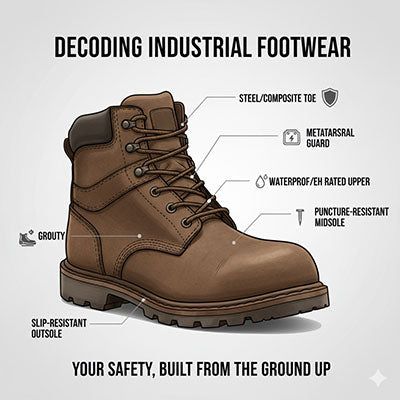
III. Decoding Industrial Footwear: Key Protection Features
Not all safety footwear is created equal. To truly "step up your safety," you need to understand the specialized features designed to combat specific hazards. Let’s break down the essential components that make industrial footwear a crucial piece of PPE.
A. Toe Protection: Your Frontline Defense
The toe cap is arguably the most recognizable feature of safety footwear, designed to protect your toes from impact and compression.
-
Steel Toe: The classic choice, steel toe caps offer maximum impact and compression resistance, capable of withstanding significant force.
-
Pros: Extremely robust, offers superior protection.
-
Cons: Heavier than other options, can conduct cold in frigid environments, and will set off metal detectors.
-
Composite Toe: Made from non-metallic materials like carbon fiber, plastic, or Kevlar, composite toes provide excellent protection without the weight or conductivity of steel.
-
Pros: Lighter weight, non-metallic (won't trigger metal detectors), non-conductive (better for electrical hazards and cold weather).
-
Cons: Can be slightly bulkier than steel, and while highly protective, may offer marginally less resistance to extreme crushing forces than steel.
-
Aluminum Toe: A good middle-ground, aluminum toe caps are lighter than steel but still offer significant protection.
-
Pros: Lighter than steel, strong protection.
-
Cons: Can be pricier than steel, and still metal (will set off detectors).
When to Choose Which: If you're working in environments with extreme heavy machinery and high crushing risks, steel is often preferred. For jobs requiring frequent walking, comfort, or where metal detectors are present (e.g., airports, some manufacturing), composite or aluminum toes are excellent alternatives.
B. Puncture Resistance: Guarding Against Underfoot Dangers
Stepping on a nail or sharp debris can be a workday nightmare. Puncture-resistant footwear incorporates a protective layer in the sole to prevent sharp objects from penetrating through the bottom of the shoe.
This feature is critical in construction, waste management, and any environment where sharp objects may be present on the ground.
C. Slip Resistance: Staying Firmly on Your Feet
Slips, trips, and falls are a leading cause of workplace injuries. Slip-resistant outsoles are engineered to provide superior traction on various slick surfaces.
-
Outsole Materials and Tread Patterns: High-quality safety footwear uses specialized rubber compounds and aggressive tread patterns designed to channel away liquids, providing a better grip on oily, wet, or icy floors.
-
Testing Standards: Reputable footwear will often meet specific ASTM or EN ISO standards (e.g., ASTM F2913 for slip resistance) that indicate they've undergone rigorous testing to prove their effectiveness.
D. Electrical Hazard (EH) Protection: Safety Around Power
EH-rated footwear is designed to protect workers from open electrical circuits by minimizing the flow of electricity through the shoe to the ground.
-
Insulation: These shoes feature non-conductive materials in the sole and heel, providing a secondary source of protection on dry surfaces.
-
When It's Needed: Essential for electricians, utility workers, and anyone working near live wires or in environments where accidental contact with electrical current is a risk.